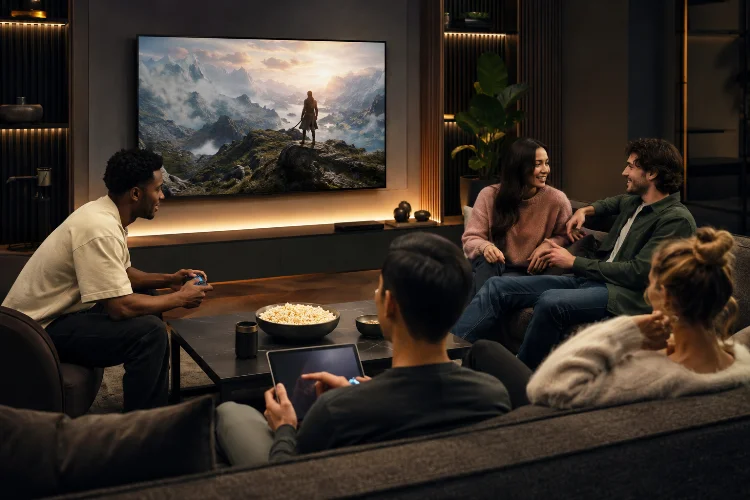
Two people can enter the same digital entertainment platform with completely different goals. One wants intense competition, another wants to hang out with friends, while someone else only has ten minutes and prefers to watch.
That difference matters when Designing Shared Experiences. Treating every audience member as though they want the same level of participation creates unnecessary friction.
Better systems recognize that audience intent changes across people, sessions, and situations. Instead of forcing everyone toward maximum interaction, they provide several comfortable ways to participate while keeping the experience socially connected.
Start With Intent Instead of User Type
Traditional audience segmentation often creates permanent labels such as “hardcore player,” “casual user,” or “viewer.”
Those labels can be useful for research, but real behavior is more fluid. The same person may compete seriously on Friday night, watch friends play on Saturday, and open the platform briefly on Monday just to check what happened.
Research into game-streaming audiences supports this idea. Studies using uses-and-gratifications theory have identified informational, entertainment, and social motivations behind streaming-platform use, with informational motivation particularly important in one study.
Design around the person’s current goal rather than assuming their identity always predicts their behavior.
Create Multiple Participation Depths
Shared experiences work better when participation is a spectrum.
At the lightest level, someone might simply observe. A little deeper, they may react, vote, or comment. Further in, they could join an activity, collaborate with others, compete, or create something themselves.
This layered model reduces the pressure to participate actively from the first second.
Research on gameplay spectatorship has shown that watching is not necessarily an inferior version of playing.
Some spectators intentionally prefer watching because it offers narrative engagement, reduces skill pressure, or avoids some of the “work” associated with direct gameplay.
That means passive-looking behavior can still represent meaningful engagement.
Avoid Treating Observation as Failure
If someone watches three friends play for an hour without joining, the platform should not automatically treat that session as unsuccessful.
They may be socializing, learning, relaxing, or deciding whether they want to participate later.
Good metrics need to reflect that possibility.
Make Moving Between Roles Easy
The most powerful shared experiences let users shift roles without starting over.
A spectator might become a participant. A player might stop playing but remain in voice chat. Someone watching a live event could join a prediction or mini-game without leaving the main experience.
Discord Activities show one practical model. Discord describes Activities as multiplayer games and social experiences that operate within its desktop, mobile, and web clients, allowing activity to exist inside an already-social environment.
The design lesson is bigger than one platform.
Reduce the distance between “watching,” “talking,” and “doing.”
Every additional menu, loading screen, invitation step, or account requirement makes role switching less likely.
Design for Different Levels of Social Energy
Audience intent is not only about content.
Sometimes people want company without conversation.
A user may be happy to sit inside a shared digital room while friends play, listen to music, or watch something. Another person may want constant voice communication and collaborative action.
Those are very different social energy states.
Shared-experience design should support quiet co-presence alongside highly active interaction. Voice chat should not always be required.
Reactions, lightweight signals, status indicators, or ambient presence can let users feel connected without demanding continual conversation.
Research on social television has found that motives can be connected to different forms of active and passive engagement, supporting the idea that shared media participation is not one uniform behavior.
Allowing different social intensities makes the experience more accesible to more situations.
Match People Around Session Intent
Traditional matchmaking often prioritizes skill, latency, and available slots.
Those variables matter, but social compatibility matters too.
A highly competitive player looking for ranked progression may not enjoy being matched with someone who wants to experiment and joke around. Both users may have identical technical skill but completely different expectations.
Xbox multiplayer services support several approaches, including matchmaking, session browsing, invites, and Looking for Group features designed to help users find others who share interests and goals.
This suggests a useful design principle: match around why people are participating, not only whether they are technically available.
A few intent signals-competitive, relaxed, learning, social, short session-can sometimes improve group fit more than another complicated skill metric.
Keep Shared Media Synchronized
Shared intent quickly breaks when participants stop experiencing the same moment.
Imagine four friends watching a digital concert remotely. One person sees the surprise reveal three seconds before everyone else and reacts immediately.
The emotional moment becomes fragmented.
Research into synchronized social viewing has highlighted timing and synchronization as important challenges when remote audiences consume media together while communicating through text or audiovisual channels.
This is especially important for live entertainment, watch parties, interactive storytelling, sports, and audience voting.
Synchronization should therefore be treated as a social feature, not merely a streaming engineering problem.
The technical system protects the shared moment.
Let Intent Change During the Session
A user’s goal at the beginning of a session may not remain the same.
Someone might arrive intending to watch, then become curious enough to participate. A competitive player may finish a match and want to stay around casually with the same group.
Designers should watch for those transitions.
Instead of displaying the same interface throughout the session, the product can surface relevant options when intent appears to change.
After spectating several rounds, for example, a subtle “Join next round” option makes sense. After finishing competitive play, the system might keep the group together while offering a lower-pressure mode.
The key is invitation rather than pressure.
Good adaptive systems make possibilities visibile without constantly interrupting the audience.
Measure Whether Intent and Experience Match
Engagement metrics become more useful when teams know what users intended to do.
A 20-minute session could be excellent for someone who wanted a quick social break and disappointing for someone expecting an evening-long event.
Product teams can combine behavioral data with optional intent signals.
Look at whether spectators eventually participate, whether relaxed groups remain together, how often people leave mismatched sessions, and how participation changes during a shared event.
Do not assume longer is always better.
A well-designed experiance succeeds when people accomplish what they came for and feel comfortable returning.
Designing Shared Experiences around audience intent means accepting that people do not always want to play, talk, compete, or create at the same intensity.
Build flexible participation levels, make roles easy to switch, support different social energy states, and preserve shared timing.
Start by mapping the major intents your audience brings into each session, then design pathways that let people move naturally between them.