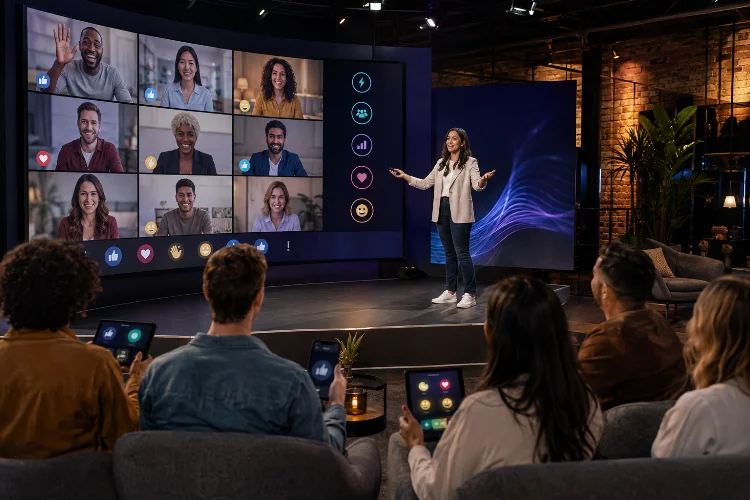
Live video becomes much more complicated the moment viewers stop being passive.
A person who only watches can tolerate a small delay, but someone answering trivia, joining a stage, voting, shopping, or reacting to a host needs the experience to feel immediate.
That is why Designing Real-Time Video Systems should begin with participation rather than video resolution. Different audience actions need different latency, permissions, and delivery models.
The best architecture does not force every viewer into the same technical path. Instead, it matches media delivery and interaction speed to what each participant actually needs to do.
Start by Defining Audience Roles
“Viewer” is often too broad a category.
A live platform may contain hosts, invited speakers, active participants, moderators, voters, chat users, and passive viewers. Each role needs different capabilities.
Amazon IVS Real-Time Streaming uses the idea of stages, where hosts and viewers can exchange video with explicit publish and subscribe capabilities. Participant tokens can control which users are allowed to publish, subscribe, or both.
This is a useful architectural pattern even if you build your own stack.
Define roles before opening media connections.
A passive viewer does not need publishing permission. Someone invited onto a virtual stage does. A moderator may need application controls without sending video.
Clear roles simplify security, interface design, and resource usage.
Match Latency to the Participation Model
Not every participant needs sub-second video.
Amazon IVS distinguishes between low-latency channels that can deliver video in under five seconds and real-time stages that can reach host-to-viewer latency below 300 milliseconds.
That difference suggests a useful tiered strategy.
A viewer watching a large concert while chatting may work perfectly well with a few seconds of delay. A contestant answering the host in real time needs something much faster.
Trying to put one million passive viewers into the most expensive real-time path can create unnecessary complexity.
Use real-time infrastructure where participation requires immediate response.
Use scalable low-latency delivery where people primarily watch.
Build a Hybrid Participation Architecture
Large interactive events often need both modes at once.
Hosts and selected participants may communicate through real-time WebRTC infrastructure, while the resulting program is distributed to a much larger audience through low-latency streaming.
Amazon IVS explicitly supports this model. Participants can interact in a real-time stage, while a stage composition can be broadcast onward to a low-latency channel for broader viewing.
This creates a practical hierarchy:
real-time stage → composed program → scalable audience delivery
A viewer can remain on the scalable path until they need to participate directly.
If they win a contest or are invited on stage, the application can move them into the real-time session.
That transition should feel like a product feature, not an infrastructure event.
Synchronize Interactive Events With the Video
Audience participation is not only about sending media quickly.
Polls, quiz questions, product cards, scores, and audience prompts must appear at the correct moment relative to what each viewer sees.
Amazon IVS timed metadata demonstrates one approach.
Metadata can be inserted into the stream and synchronized with specific audio and video frames, allowing clients to trigger events such as sports statistics, shopping details, or quiz questions at the same point in playback.
That is often more reliable than simply sending a web request when the host says something.
A viewer might be two seconds behind another viewer.
If everyone receives a quiz question according to wall-clock time, some users could see the question before the host has asked it.
Tie important interactions to media time when fairness or context matters.
Good interactivty feels synchronized, not merely fast.
Design Participation as a State Machine
Audience roles can change during a session.
A passive viewer becomes a voter. A voter becomes an invited guest. A guest leaves the stage and becomes a viewer again.
Architecture should explicitly model those transitions.
For example:
Viewer → Eligible Participant → Invited Participant → Live Participant → Viewer
Each state can have different permissions, UI controls, network requirements, and media subscriptions.
Amazon IVS stages use participant tokens to authorize stage access and capabilities, which illustrates why participation state should be connected to backend authorization rather than controlled only by interface buttons.
Do not let the client decide by itself that someone is suddenly a broadcaster.
The backend should remain the source of truth.
That becomes especially important once events include contests, paid access, moderation, or limited stage capacity.
Plan for Cross-Stage Interaction
Large social-video systems may contain many simultaneous rooms.
Sometimes participants from different rooms need to interact.
Amazon IVS participant replication provides a useful example. It can replicate a participant from one stage into another, supporting patterns such as head-to-head competitions between creators whose audiences remain in separate stages.
This model can scale better than pushing every participant into one giant room.
Imagine two creators each broadcasting to their own community.
During a competition, their media can temporarily appear across both environments.
When the event ends, each audience returns to its existing room.
Architecture built around composable participation spaces is usually more flexible than one enormous global session.
Separate Media From Interaction Data
Video is only one part of participation.
Chat messages, reactions, game inputs, cursor positions, score changes, and control events may need different reliability characteristics.
Cloudflare Realtime SFU, for example, supports both WebRTC media tracks and DataChannels. Its DataChannels can carry low-latency application data such as chat, game state, sensor information, or control events.
Developers can also choose reliable delivery or partial reliability depending on whether delayed information is still useful.
That distinction is powerful.
A payment confirmation should be reliable.
A rapidly changing game-position update may be useless if it arrives one second late.
Do not force every application event through the same delivery semantics.
Choose transport behavior according to what the information means.
Design for Difficult Networks
Audience participation must work outside ideal Wi-Fi.
Real-time media can face NAT restrictions, firewalls, packet loss, jitter, and mobile-network changes.
Amazon IVS Real-Time Streaming uses WebRTC and relies on UDP for low-latency media by default. Its documentation notes that TCP fallback can be available for subscribing in some situations, while publishing requires UDP connectivity.
This matters during product design.
A user may be able to watch but unable to become a broadcaster from a restrictive network.
The interface should detect this before putting them through a confusing stage-invitation flow.
Run network checks early when participation is important.
Communicate limitations clearly.
Reliablity includes graceful failure, not merely ideal-path performance.
Measure Participation Quality
A real-time system can technically succeed while the experience still feels poor.
Monitor more than connection count.
Amazon IVS exposes stage and participant metrics including publisher counts, subscriptions, frame rates, resolutions, and simulcast layers.
Your own analytics should connect technical measurements with product outcomes.
Track stage-join success, invite acceptance, time to first media, dropped participants, delayed responses, failed votes, audio interruptions, and the percentage of invited users who successfully become publishers.
Then examine participation outcomes.
Did viewers actually respond before the poll closed? Could guests speak without awkward delay? Did switching between viewer and participant states feel smooth?
Architecture exists to support the social experience.
The infrastructure graph is only one part of the answer.
Designing Real-Time Video Systems around participation means giving different audience roles the latency, permissions, and delivery path they actually need.
Combine real-time stages with scalable viewing, synchronize interactions to media, model role changes explicitly, and measure whether people can participate succesfully.
Start by mapping every audience role in your live product and define what “real time” truly means for each one.